
Plantation Shutters Cost vs Value Guide: Sydney Pricing & ROI Explained
Plantation shutters rank among the highest-equity window treatments available to Sydney homeowners, but the spread between PVC, timber and aluminium pricing confuses most buyers before they have even requested a quote. This guide breaks down real Greater Sydney pricing per square metre, explains where the genuine value sits, and shows Inner West homeowners exactly what return they can expect from a shutter installation.
Table of Contents
- What Are Plantation Shutters? A Technical Overview
- How Plantation Shutters Perform in Sydney’s Climate
- PVC vs Timber vs Aluminium: Choosing the Right Shutter
- Plantation Shutter Costs in Sydney: Realistic Price Ranges
- Cost vs Value: Do Plantation Shutters Pay You Back?
- The Installation Process: What to Expect
- Frequently Asked Questions
What Are Plantation Shutters? A Technical Overview
Plantation shutters are louvred, hinged panels fixed permanently into or onto a window frame, built from PVC, timber or aluminium, and operated by tilting horizontal blades to control light, airflow and privacy. Unlike blinds or curtains, a shutter is a structural fixture rather than a furnishing, which is why bank valuers and prospective buyers treat it as a permanent addition to the property.
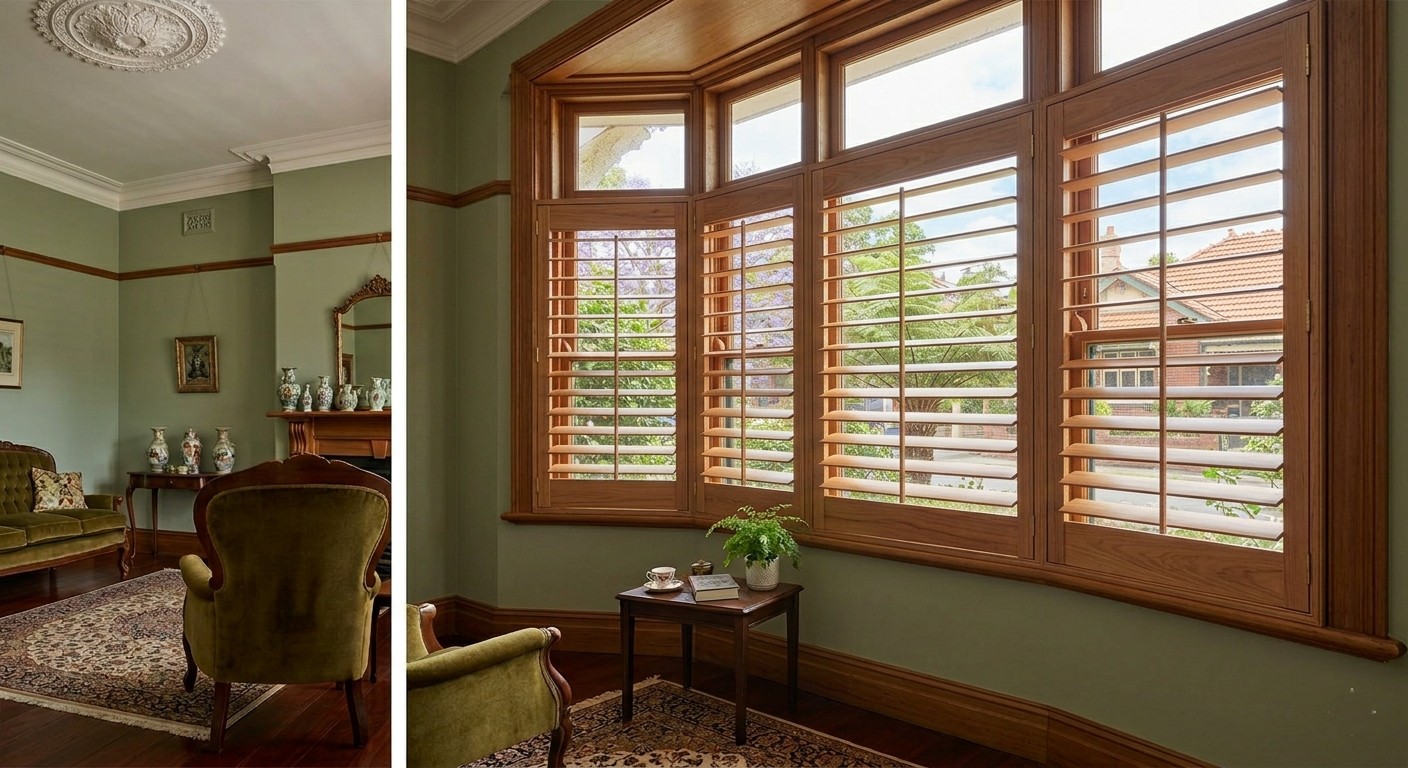
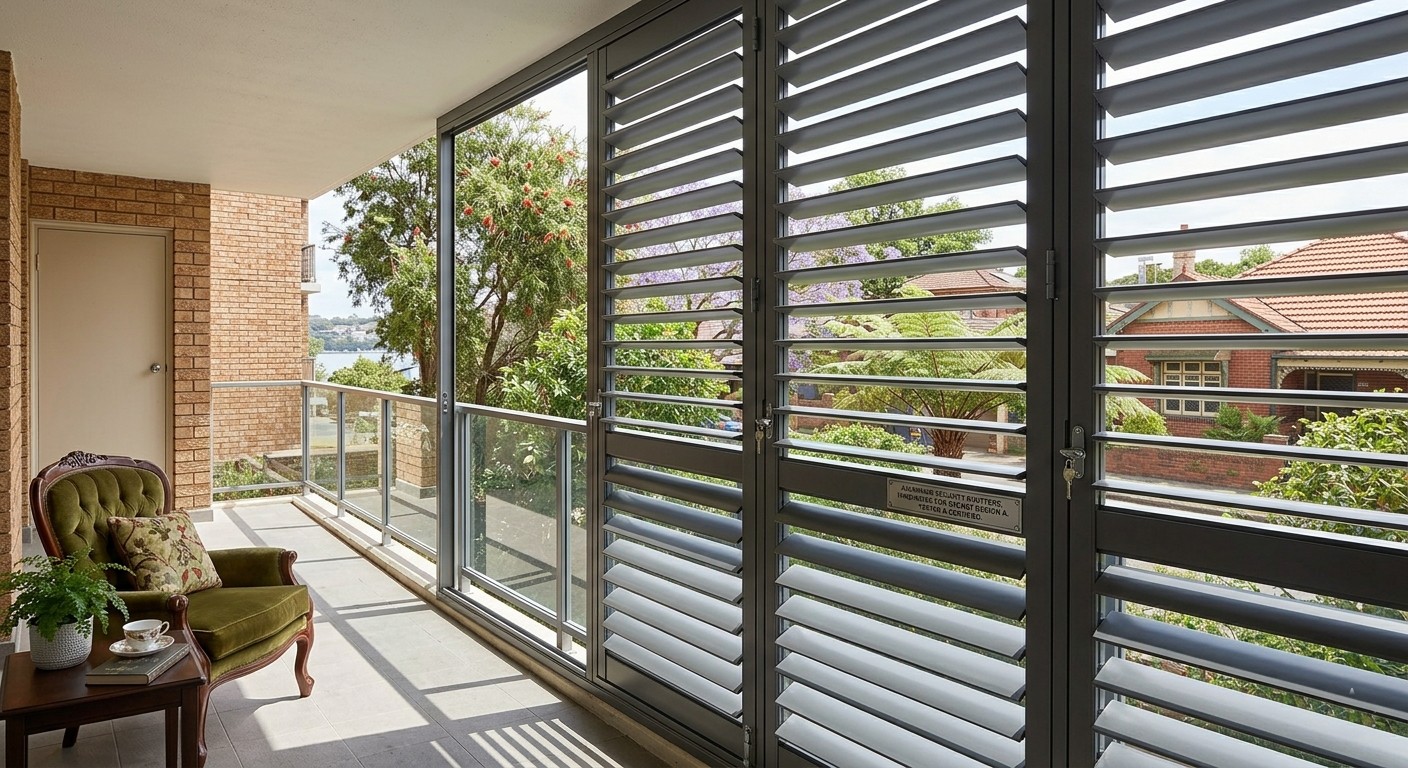
Three core materials dominate the Sydney market, each suited to different rooms and budgets. PVC (sometimes marketed as polyresin or thermopoly) resists moisture and will not warp, making it the standard choice for bathrooms, laundries and coastal properties. Timber, typically Western Red Cedar or basswood, delivers the warmest aesthetic and is the material most associated with heritage Federation and Victorian facades across the Inner West. Aluminium sits at the upper end for exterior and security applications, where wind load and structural rigidity matter more than warmth of finish.
| Material | Typical Louvre Width | Best Application | Moisture Resistance |
| PVC / Polyresin | 63mm–89mm | Bathrooms, laundries, rental properties | Excellent |
| Timber (Cedar/Basswood) | 89mm–114mm | Living rooms, heritage facades, bedrooms | Moderate, requires sealing |
| Aluminium | 89mm–150mm | Exterior screens, security applications, and balconies | Excellent |
Louvre width has shifted noticeably in 2026, with Inner West homeowners favouring the wider 89mm to 114mm blade in soft, warm white finishes that echo the original paint schemes of Federation cottages. Narrower 63mm louvres remain common in smaller wet areas where panel weight and frame depth are constraints.
How Plantation Shutters Perform in Sydney’s Climate
Sydney’s western and northern aspects carry heavy afternoon solar load, and shutters address this directly by giving homeowners adjustable louvre control instead of the binary choice forced by a single roller blind: block everything out, or accept the heat and glare. In the Inner West specifically, narrow street setbacks compound the problem, since west-facing windows in suburbs like Leichhardt and Balmain often sit only metres from the footpath.
Tilting the louvres to a steep angle deflects direct sun while still allowing ambient light and airflow through the slats, keeping rooms usable during peak summer afternoons without resorting to full blockout darkness. This is a genuine point of difference from roller blinds, which can only be fully open or fully closed.
For motorised shutter systems, every electrical drive component must comply with AS/NZS 60335.2.97:2024, which governs insulation, thermal overload protection and structural safety for drives operating up to 250V on single-phase circuits, alongside the general electrical safety requirements set out in AS/NZS 60335.1:2022. Exterior aluminium shutters are subject to a separate structural standard, AS/NZS 1170.2:2021, which dictates wind load calculations specific to Sydney’s Wind Region A classification, ensuring panels will not detach or deform under storm-force gusts.
Rule of thumb from the trade floor: if a window faces west and sits within five metres of a neighbouring wall or fence line, wider 89mm–114mm louvres in a light colourway do more work for both privacy and heat deflection than a narrower blade.
PVC vs Timber vs Aluminium: Choosing the Right Shutter
Each shutter material trades off differently between cost, moisture tolerance and aesthetic, and the right choice depends on the room rather than the house as a whole. PVC suits wet areas and budget-conscious installs, timber suits street-facing facades where kerb appeal matters, and aluminium suits exterior or security-rated applications where structural performance is the priority.
PVC panels will not swell, crack or discolour from humidity, which makes them the default recommendation for bathrooms and laundries regardless of budget. They are also the lightest option, putting less strain on hinges over a 10 to 15-year lifespan. Timber carries more visual warmth and is generally specified for living areas, bedrooms and any room visible from the street, since it integrates with original architraves and skirting in a way PVC cannot replicate. The trade-off is that timber requires periodic resealing in high-humidity rooms and carries a higher per-square-metre cost. Aluminium is rarely chosen for interior aesthetics, but for exterior screening or security retrofits on ground-floor windows, it is the only material rated for sustained wind load and impact resistance.
For a typical Inner West terrace, the practical split most installers recommend is PVC in the bathroom and laundry, timber through the living areas and street-facing bedrooms, and aluminium reserved for any exterior or security-specific application such as a rear courtyard or ground-floor window facing a laneway.
Plantation Shutter Costs in Sydney: Realistic Price Ranges
Plantation shutters are priced per square metre in the Sydney market, with the final figure determined by material, louvre width, frame complexity and whether the installation includes motorisation. The ranges below reflect current Greater Sydney market data for supply and professional installation.
| Shutter Type | Low-End (per m²) | Mid-Range (per m²) | Premium (per m²) |
| PVC Plantation Shutters | $250–$300 | $300–$350 | $350–$450 |
| Timber Plantation Shutters | $300–$400 | $400–$550 | $550–$700+ |
| Aluminium Shutters | $350–$400 | $400–$450 | $450–$500+ |
On top of material supply, installation labour for plantation shutters runs at $100 to $200 per panel, reflecting the specialised framing alignment that hinged louvre systems demand compared with a simple blind bracket. Motorised configurations add a further $150 to $300 per motor for mounting and calibration, plus $180 to $270 per electrical point if a licensed electrician is required for a hardwired 240V connection.
For context, a complete plantation shutter package across an average three-bedroom Sydney home, supplied and installed, typically lands between $4,000 and $8,000. Where a project comes in below that range, it is worth checking whether the quote includes structural framing adjustments for non-standard window openings, since heritage properties in suburbs like Strathfield and Drummoyne frequently require custom packing or architrave extensions that ready-made systems cannot accommodate.
Cost vs Value: Do Plantation Shutters Pay You Back?
Plantation shutters return value through three separate channels: property equity, energy savings and, for security-rated aluminium systems, measurable risk reduction. Because shutters are fixed to the building rather than hung as soft furnishings, valuers classify them as a permanent fixture, meaning the cost is factored into bank valuations in a way that curtains and blinds generally are not.
The energy savings case is straightforward physics. A correctly fitted shutter with tightly closing louvres reduces direct solar gain through west-facing glass, which lowers the load on air conditioning during Sydney’s peak summer months and reduces heat loss through the same glazing in winter. That dual benefit is what separates shutters from single-season window treatments.
Where homeowners install aluminium security shutters specifically, the value case extends further. Fully closed security shutters act as a physical barrier against forced entry, can reduce heat transfer through the affected window by up to 90%, and dampen external street-level noise by as much as 50%, a meaningful figure for properties facing arterial roads or flight paths near the Inner West. They also offer a layer of protection against storm debris during severe weather events.
The honest assessment for most Inner West homeowners: PVC and timber plantation shutters earn their cost back primarily through equity and thermal comfort over a 10 to 15 year lifespan, while aluminium security shutters justify a higher upfront spend through the added layers of acoustic and intrusion protection on top of the same thermal benefits.
The Installation Process: What to Expect
- In-home consultation and measurement. A consultant visits the property to measure each opening, assess frame condition, and confirm louvre width and material based on the room’s function and the home’s architectural style.
- Custom fabrication. Panels are built to the exact window dimensions, with timber and PVC orders typically taking 3 to 5 weeks and aluminium security systems running closer to 5 to 7 weeks due to structural certification requirements.
- Pre-installation site check. Installers confirm frame squareness and, for motorised orders, coordinate access for the licensed electrician ahead of the install date.
- Fitting day. Panels are hung, hinges aligned, and for corded or motorised systems, all cord guides, tensioning devices and cleats are fixed in compliance with the mandatory ACCC corded window covering safety standards, including the 1,600mm minimum cleat height.
- Compliance labelling and handover. A permanent installer label is affixed as legally required, the homeowner is walked through louvre operation and cleaning, and any electrical components are tested and signed off.
- Warranty and aftercare. Most plantation shutter installations in Sydney carry a structural warranty of 5 to 10 years, depending on material, with timber requiring an occasional resealing check in high-moisture rooms.
Frequently Asked Questions
How much do plantation shutters cost in Sydney? Prices in Sydney typically range from $250 to $700 per square metre, depending on the material. Durable PVC and polyresin shutters for wet areas cost $250 to $350 per m², while natural hardwood timber shutters range from $300 to $700 per m². For an average three-bedroom Sydney home, the complete package ranges from $4,000 to $8,000 supplied and installed.
Are outdoor blinds waterproof? Performance depends on the material. Heavy-duty extruded PVC blinds, such as track-guided Ziptrak systems, are fully waterproof and windproof, making them suited to outdoor patios. Woven shade mesh fabrics are weatherproof rather than fully waterproof; they block up to 98% of UV rays but can allow a fine mist through during extreme wind and rain.
How much does it cost to install window shades? Professional installation in Australia averages $400 to $800 per window for custom, premium treatments. For standard retrofits, installers typically charge $50 to $100 per window in labour, or $20 to $50 per square metre. Motorised setups and specialised custom shapes increase the installation cost.
Are security shutters worth it? Yes. Security shutters deliver structural return on investment through several pathways. When fully closed, they act as a physical barrier against forced entry, reduce heat transfer by up to 90%, lower electricity consumption, and dampen external street-level noise by up to 50%. They also protect windows against storm debris.
Do plantation shutters add value to the home? Yes. Plantation shutters are classed as permanent fixtures rather than temporary dressings, which means they add direct equity to the property and are factored into bank valuations. They improve the home’s street-facing aesthetic appeal, provide measurable insulation, and are popular with prospective buyers.
Ready to compare plantation shutter options for your home? Book a free in-home measure and quote with Decorating Decor Interiors at 104 Hampden Road, Russell Lea NSW 2046, or call (02) 9712 2722 to speak with the showroom team directly.