
Timber vs Aluminium vs Polyresin Shutters: Which Material Suits Your Sydney Home?
Choosing between timber, aluminium and polyresin shutters affects more than appearance. Each material responds differently to Sydney’s coastal humidity, UV exposure and seasonal wind loads, and each carries distinct compliance obligations under Australian Standards. This guide breaks down structural performance, realistic pricing and the AS/NZS specifications that determine whether a shutter lasts fifteen years or fails within three.
TABLE OF CONTENTS
- What Are Timber, Aluminium and Polyresin Shutters? A Technical Overview
- How Timber, Aluminium and Polyresin Shutters Perform in Sydney’s Climate
- Choosing the Right Shutter Material: Options Compared
- Shutter Costs in Sydney: Realistic Price Ranges
- The Installation Process: What to Expect
- Frequently Asked Questions
What Are Timber, Aluminium and Polyresin Shutters? A Technical Overview
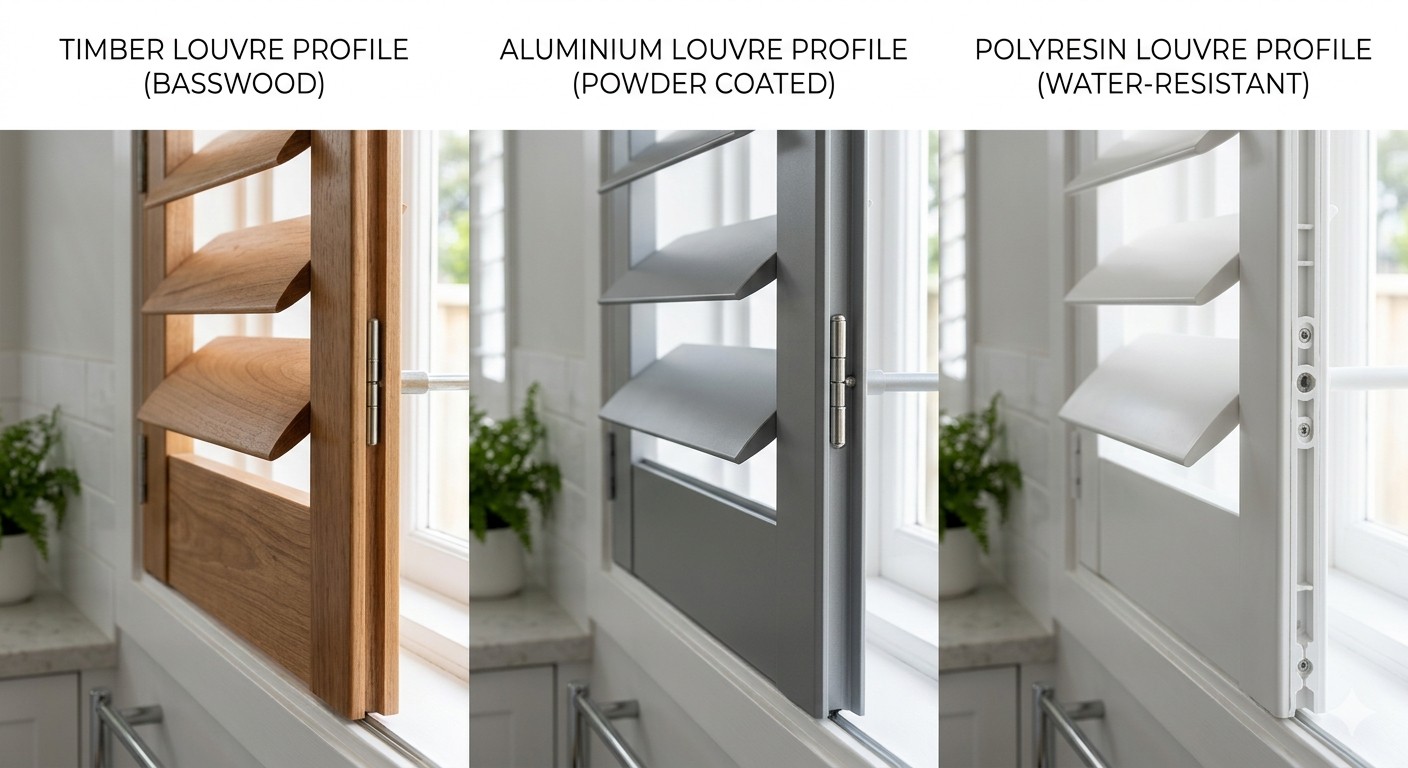
Timber, aluminium and polyresin shutters are rigid, louvred or solid-panel window coverings built from three structurally distinct base materials, each engineered for a different combination of weight, moisture resistance and load tolerance. Timber relies on natural grain strength, aluminium on extruded metal rigidity, and polyresin on multi-chambered polymer cavities reinforced with internal aluminium cores.
The three systems are not interchangeable on a like-for-like basis. Timber panels, typically Basswood, Cedar or Paulownia, are prized for their low weight-to-strength ratio, which makes them suitable for wider single panels without sagging at the hinge point. Aluminium systems use extruded, powder-coated alloy profiles, often 6063-T6 marine-grade stock, that offer the highest structural rigidity of the three and the only realistic option for external, wind-exposed applications. Polyresin, sold by DDI under the Thermopoly range including the Thermo25 line, is a hollow-cavity polymer that traps air within its profile, giving it thermal and moisture properties neither timber nor raw aluminium can match on their own.
| Feature | Timber | Aluminium | Polyresin (Thermopoly) |
| Base Material | Basswood, Cedar, Paulownia | Extruded 6063-T6 powder-coated alloy | Hollow-chamber polymer, aluminium-reinforced core |
| Weight Profile | Light to moderate | Moderate to heavy | Light, rigid |
| Moisture Tolerance | Poor in humid zones | Excellent (corrosion-resistant when coated) | Excellent, fully waterproof |
| UV Stability | Moderate, prone to fade/paint cracking | High with AS 3715 coating | High with UV-stabilised ABS |
| Best Use Zone | Dry living areas, bedrooms | External, coastal, BAL-rated zones | Kitchens, bathrooms, laundries |
| Typical Warranty (DDI) | 2-year design/alignment, up to 15-year on premium dense-grain stock | 2-year mechanical, up to 25-year/lifetime structural | 2-year standard, 25-year on Thermopoly structural |
How Timber, Aluminium and Polyresin Shutters Perform in Sydney’s Climate
Sydney’s combination of coastal salt exposure, subtropical humidity and bushfire-interface zoning means no single shutter material performs optimally in every suburb or every room. Material selection has to be matched against AS/NZS compliance requirements and the specific microclimate of the installation site, not chosen on appearance alone.
Coastal suburbs such as Bondi, Manly and Cronulla, along with harbour-fronting pockets along the Parramatta River, expose external fixtures to airborne salt spray and continuous UV radiation that degrade standard paints and cheap imported plastics within a few years. Aluminium shutters finished to AS 3715:2025 (Thermoset powder coatings for architectural aluminium) are built to withstand this. The 2025 revision aligns coating performance with AS 4312 atmospheric corrosivity categories, and Sydney’s coastal zones sit in the C4 to C5 high-salinity bracket, requiring Class 2 coatings such as Dulux Duratec or Interpon D2525 at a minimum 60-micron thickness with cross-hatch adhesion testing.
For external installations on balconies, alfresco areas and street-facing windows, AS/NZS 1170.2 (Structural design actions: Wind actions) governs the structural calculations. Heavy-duty aluminium systems can be rated to handle wind speeds exceeding 200 km/h in designated wind regions, a tolerance neither timber nor polyresin can structurally match externally.
Inside the home, the equation flips. Suburbs bordering the Parramatta River, such as Concord and Five Dock, see elevated summer humidity, and timber installed in kitchens, laundries or bathrooms absorbs that moisture, leading to swelling, paint flaking and joint separation within a few seasons. DDI’s Thermopoly Thermo25 polyresin range is built for exactly this zone: a fully waterproof, non-toxic polymer resin with an aluminium-reinforced core that resists warping and supports simple wipe-down maintenance.
All internal shutter systems, regardless of material, must meet AS 2663.1 and AS 2663.3 for opacity, durability and testing criteria to be certified for Australian residential use. Note that AS/NZS 4836:2014, sometimes referenced incorrectly in relation to polymer shutters, actually governs low-voltage electrical work and has no bearing on shutter material compliance.
Thermal performance is governed by the standard heat flow relationship Φ = A·ΔT/R, where R is the thermal resistance of the shutter system. Polyresin’s multi-chambered profile gives it a naturally higher R-value than uninsulated metal, capable of reducing heating and cooling demand by up to 30% and supporting alignment with 7-star NatHERS baselines. Aluminium achieves comparable thermal performance only when manufactured with polyamide thermal breaks separating the interior and exterior metal faces.
For heritage terraces in Balmain, Leichhardt, Rozelle and Strathfield, where single-glazed timber windows are common and draughty, a precision-fitted shutter of any material creates a sealed dead-air cavity that reduces conductive heat loss and improves acoustic insulation, while adjustable louvres direct light upward and block street sightlines.
Rule of thumb from the trade: if the room has a shower, bath, sink or direct steam exposure, polyresin is the only material that won’t need replacing within five years. If the install is external and street-facing, aluminium is the only material that will pass a wind-load assessment.
Choosing the Right Shutter Material: Options Compared
Material selection in practice comes down to three filters applied in sequence: location (internal vs external), moisture exposure, and budget tier. Skipping this sequence is the most common cause of premature shutter failure and warranty disputes in the Sydney market.
For dry internal living areas, bedrooms and studies, premium hardwood timber such as stained Western Red Cedar delivers the best aesthetic outcome and supports wide single panels without a centre rail, which most homeowners prefer for unobstructed sightlines. Basswood at the mid tier offers a lighter, more budget-conscious alternative with the same paint-grade finish options.
For kitchens, bathrooms, laundries and any room with sustained humidity or steam, polyresin is the only material that should be specified. DDI’s Thermopoly Thermo25 line carries a 25-year structural warranty on the non-toxic, recyclable polymer and will not swell, crack or harbour mould in the way timber does in these zones.
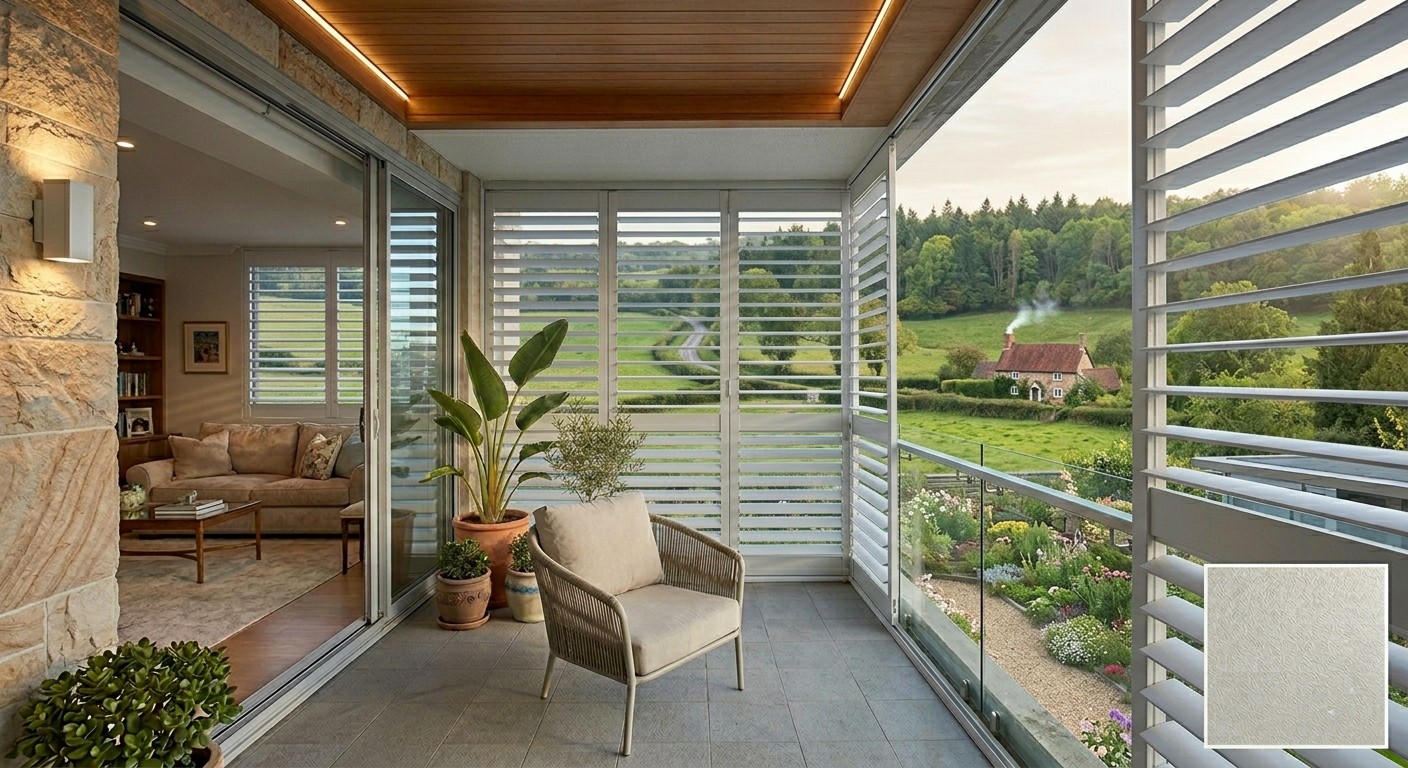
For external applications, including balcony enclosures, alfresco entertaining areas, and any street-facing or coastal-exposed window, powder-coated aluminium is the only structurally appropriate choice. It is the sole material of the three that can be engineered to BAL-40 bushfire certification under AS 3959-2018, using non-combustible high-tensile extrusions and stainless steel hardware to withstand radiant heat up to 40 kW/m² and direct ember attack.
For a typical Russell Lea or Inner West terrace homeowner renovating a kitchen and adjoining living room, the practical recommendation is a mixed-material approach: Thermopoly polyresin in the kitchen and bathroom, premium timber in the living and bedroom zones, and aluminium reserved for any external balcony or alfresco opening. This is the configuration DDI specifies most frequently for Inner West clients, and it avoids the total-cost-of-ownership trap of installing timber in a wet zone.
Shutter Costs in Sydney: Realistic Price Ranges
Pricing for a standardised 1200mm x 1200mm opening, supplied and installed, varies by material, tier and structural complexity, with professional installer labour in the Sydney market running between $70 and $150 per hour, depending on access and difficulty.
Polyresin / Advanced Polymer (Thermopoly, PVC)
| Tier | Cost per m² | Supplied & Installed (1200x1200mm) | Surcharges | Warranty Benchmark |
| Low (Basic DIY / Imported) | $250–$300 | $300–$450 | Standard reveal/face mounts only; high measurement-error risk | 1–5 year product replacement |
| Mid (Standard Custom Fit) | $300–$350 | $450–$650 | Tracked sliding door systems: $450–$600/m² | DDI 2-year workmanship |
| Premium (Aluminium-reinforced, AU made) | $350–$450 | $650–$950 | Multi-panel bi-folds and custom framing | 25-year structural (Thermopoly) |
Hardwood Timber (Basswood, Cedar, Paulownia)
| Tier | Cost per m² | Supplied & Installed (1200x1200mm) | Surcharges | Warranty Benchmark |
| Low (Engineered MDF / Imports) | $300–$380 | $500–$750 | Unsuitable for wide spans, sag risk | Limited; moisture-prone |
| Mid (Custom Painted Basswood) | $380–$500 | $800–$1,200 | Track-guided sliding systems: $500–$700/m² | DDI 2-year design/alignment |
| Premium (Stained Hardwood, Western Red Cedar) | $500–$700 | $1,200–$1,800+ | Bi-fold/multi-fold on heavy-duty lintels | Up to 15-year factory |
Aluminium (Extruded, Powder-Coated)
| Tier | Cost per m² | Supplied & Installed (1200x1200mm) | Surcharges | Warranty Benchmark |
| Low (Standard Internal / Light-Gauge) | $350–$400 | $550–$800 | Standard fixed/hinged configurations | Limited colour-match |
| Mid (External Grade / Security Lockable) | $400–$550 | $900–$1,500 | Multi-point locks, keyway integration | DDI 2-year mechanical |
| Premium (Cyclone-Rated, BAL-40, Marine-Grade) | $550–$750+ | $1,500–$2,200+ | Commercial dual-wall profiles, custom RAL colours | 25-year to lifetime structural |
The headline figures only tell half the story. Timber and polyresin both carry a lower entry price than premium external aluminium, but the total cost of ownership depends heavily on where the shutter is installed. Timber fitted into a humid kitchen or bathroom degrades faster and typically needs replacement well inside its expected lifespan, while a Thermopoly polyresin install in that same wet zone carries a materially lower lifetime cost because it does not need premature replacement.
The Installation Process: What to Expect
- In-home consultation and measurement. A DDI decorator visits the property to assess room zoning, moisture exposure, sun direction and any structural constraints such as architraves or non-standard frame depth, then takes laser measurements for an exact fit.
- Material and configuration selection. Based on the zone assessment, the client selects material (timber, aluminium or polyresin), panel configuration (hinged, bi-fold, sliding-tracked) and finish, with surcharge items such as tracking systems quoted at this stage.
- Custom fabrication. Panels are manufactured to the exact opening dimensions. Standard lead time runs several weeks, depending on material and finish; premium stained hardwood and custom RAL aluminium colours typically sit at the longer end of that window.
- Site preparation and structural fitting. For external aluminium installs, framing is fitted and checked against AS/NZS 1170.2 wind-load requirements before panel hanging. For internal timber and polyresin, reveal or face-mount frames are fitted to the architrave.
- Installation and mechanical adjustment. Panels are hung, hinges and tilt mechanisms calibrated, and tracked or bi-fold systems tested for smooth glide clearance against door or window hardware.
- Handover, warranty activation and aftercare briefing. The client receives operating instructions, warranty documentation (2-year standard workmanship on all DDI installs, extending to 15–25 years on premium timber and Thermopoly structural components, respectively), and basic cleaning guidance specific to the material installed.
Frequently Asked Questions
Are PVC or timber shutters better? It depends on the room. Premium timber such as Basswood is lighter and well-suited to wider panels in dry living areas, while waterproof polyresin (Thermopoly) outperforms timber in moisture-prone zones like kitchens and bathrooms, where timber is prone to swelling and paint damage.
How much do plantation shutters cost in Sydney? Supplied and installed pricing for a standard 1200mm x 1200mm opening ranges from roughly $300 at the entry polyresin tier to over $2,200 for premium BAL-40-rated external aluminium. DDI’s end-to-end service, including in-home consultation, laser measurement and professional installation, avoids the fitting errors common with cheap DIY kits.
Are aluminium shutters better than PVC outdoors? Yes, for external applications. PVC and polyresin can soften or warp under sustained direct outdoor heat and UV exposure, whereas powder-coated aluminium offers far greater structural rigidity, storm resilience and long-term durability for patios, balconies and alfresco areas.
Can shutters be installed on sliding doors? Yes. DDI fits specialised tracked systems, including bi-fold and sliding shutter configurations, engineered to glide smoothly without interfering with the sliding door’s existing hardware or obstructing high-traffic entryways.
Are aluminium plantation shutters suitable for outdoor use? Yes, when manufactured from high-tensile marine-grade aluminium extrusions with UV-stabilised ABS components and an AS 3715-compliant powder-coated finish. This combination resists pitting and salt-spray corrosion, making aluminium the appropriate choice for coastal and exposed external installs.
Not sure which material suits your home? Book a free in-home measure and quote with DDI’s design team and get a zone-by-zone material recommendation before you commit.