
Decor Interiors has been supplying and installing awnings for Sydney homes since 1991. As an authorised Luxaflex dealer and Hunter Douglas Gallery dealer based in Russell Lea, we cover everything from classic fabric folding arm awnings to fully motorised outdoor systems for Inner West balconies, patios, and west-facing walls. If you want awnings Sydney homeowners can rely on through hot summers and windy winters alike, we measure, supply, and install the full range.
Awnings Sydney: Fabric, Motorised and Custom Outdoor Awnings
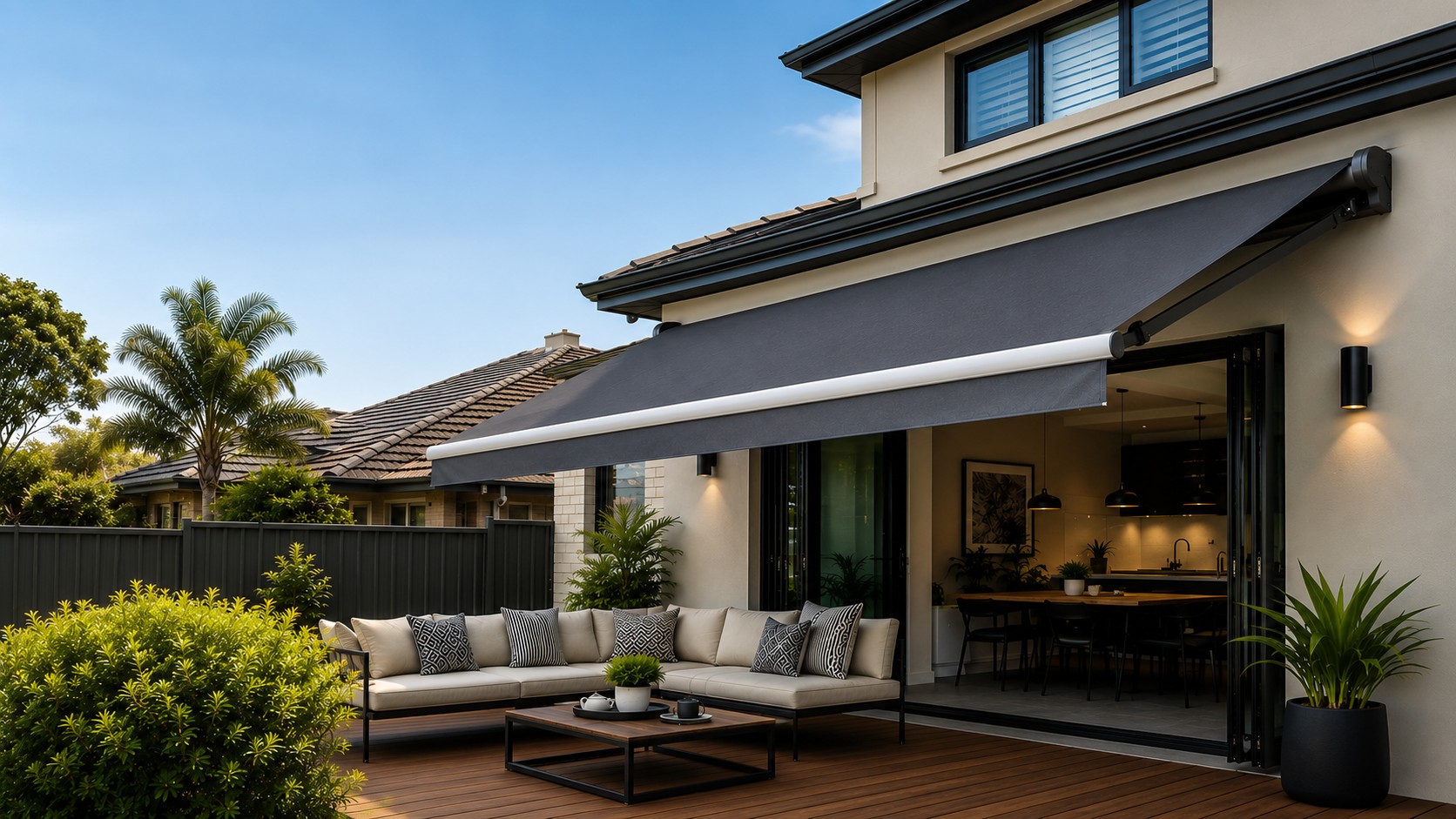
- According to YourHome, external shading such as awnings can reduce summer heat gain through windows by up to 87% when correctly sized and positioned.
- Folding arm awnings are the most popular retractable awning style in Sydney because they project outward without vertical supports, keeping the view clear.
- Motorised awnings with wind sensors retract automatically when gusts exceed a set threshold, helping protect the fabric and frame from storm damage.
- Acrylic awning fabric resists UV degradation, mould, and fading significantly better than polyester alternatives in Sydney’s humid coastal climate.
- Luxaflex awnings are manufactured to Australian wind load standards and carry a Sun Protection Factor rating, making them measurable as sun protection products rather than just shade structures.
Types of Awnings: Fabric, Crank, and Motorised
Not all awnings work the same way, and choosing the wrong operating system for your space is one of the most common mistakes buyers make. There are three main categories to understand before you commit.
Fabric Folding Arm Awnings
Folding arm awnings are the most popular choice for patios, decks, and entertaining areas across Inner West Sydney. They project outward from the wall on pre-tensioned articulating arms, covering a shaded area without the need for support posts. This keeps your outdoor floor space completely clear.
Most residential folding arm awnings cover widths between 2.5 and 7 metres, with projections of 2 to 4 metres. The fabric carries most of the visual weight, so choosing the right colour and weave matters as much as the hardware. Acrylic fabrics resist fading and mould better than standard polyester, and solution-dyed acrylics perform best in Sydney’s UV conditions over the long term.
A key decision is whether to go open roller, semi-cassette, or full-cassette. An open roller system has no housing and leaves the fabric exposed when retracted. A semi-cassette covers the top and front but leaves the arms visible. A full-cassette enclosure encloses the fabric and hardware completely when retracted, protecting the system from weather, debris, and UV degradation when not in use. For rooftop terraces and exposed balconies in Drummoyne or Balmain, a full-cassette or semi-cassette is the smarter long-term investment.
Crank-Operated Awnings
Crank operation is the standard entry point for folding arm awnings. A wall-mounted handle winds the awning in and out using a smooth-action mechanism. It is reliable, maintenance-friendly, and costs less than motorised alternatives.
For awnings up to around 4 metres wide, crank operation is perfectly practical. Beyond that width, the physical effort of winding becomes noticeable, and most installers recommend stepping up to motorisation. If you have a small balcony or a single-window pergola overhang in Rozelle or Annandale, a crank system can be an excellent fit.
Motorised Awnings Sydney
Motorised awnings operate at the touch of a button, via a wall switch or remote control. The motor drives the roller tube, extending and retracting the awning smoothly without manual effort. Most motorised systems can also be integrated with sun and wind sensors, which automate the process further. The awning extends when the sun intensity reaches a set threshold and retracts automatically when wind speed rises above a safe operating level.
For larger awnings, motorisation is not a luxury. Winding a 6 or 7 metre wide folding arm system by hand is physically demanding and risks uneven tension across the fabric. With a motor, the movement is controlled, even, and consistent every time.
Motorised awnings in Sydney typically add $400 to $800 to the cost of a comparable crank system, depending on the motor specification and brand. Wind and rain sensors add a further $200 to $400 but are strongly recommended for exposed locations near the water in Drummoyne or on elevated properties in Balmain.
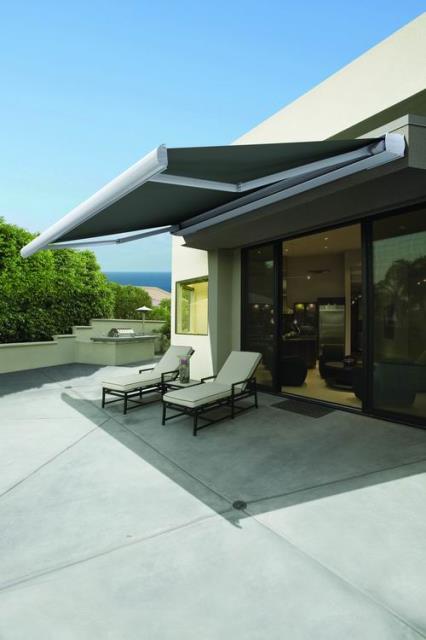
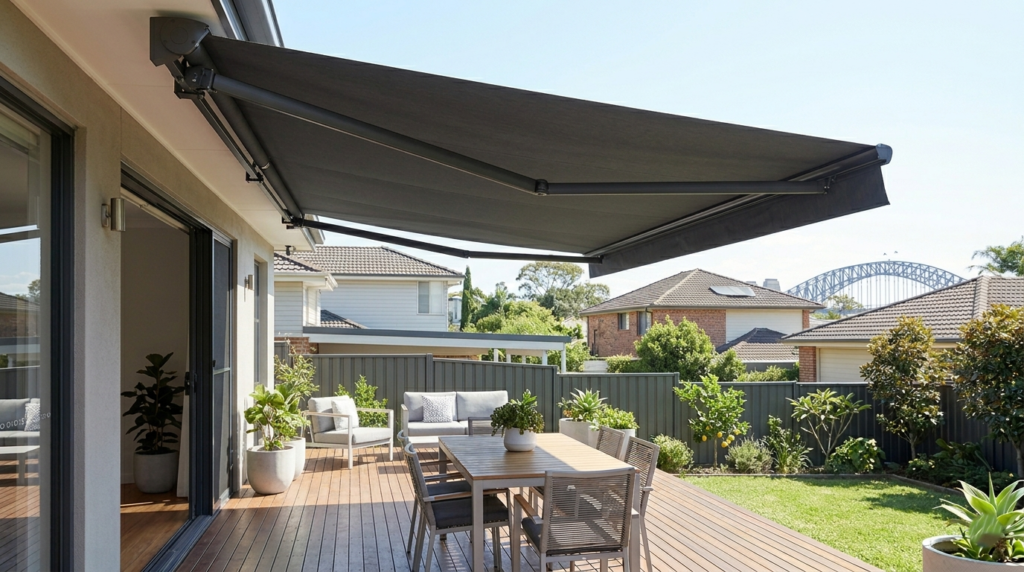
Luxaflex Awnings Sydney
Luxaflex is the most comprehensive awning brand available through authorised dealers in Australia, and DDI is one of Sydney’s authorised showrooms. The range goes well beyond what most competitors stock, with multiple series designed for different budgets, architectural styles, and installation requirements.
The Luxaflex Contemporary Series
The Contemporary Series is designed for modern Australian homes and is the most popular choice among DDI’s Inner West customers. It includes folding arm awnings in open, semi-cassette, and full-cassette configurations, with a clean, European-influenced aesthetic that suits both Federation-era renovations and new builds alike.
Key models in this range include the Nordic Series, which covers widths up to 7 metres with a 4 metre projection and includes optional variable pitch control. Pitch control is a useful feature in Sydney, where the angle of the afternoon sun changes significantly across summer and winter. The SunRain Awning is a Gallery-exclusive model engineered specifically for Australian conditions, combining rain hood protection with folding arm function so the awning can remain partially deployed even in light rain. The Eclipse Semi is a semi-cassette model with pitch control functionality, available in widths up to 7 metres in both crank and motorised options.
All Contemporary Series awnings are available in standard and powder-coat colour finishes to match exterior colour schemes. Certain models include optional integrated heating and lighting, which extends the usability of covered outdoor spaces into Sydney evenings.
Luxaflex Evo Awnings
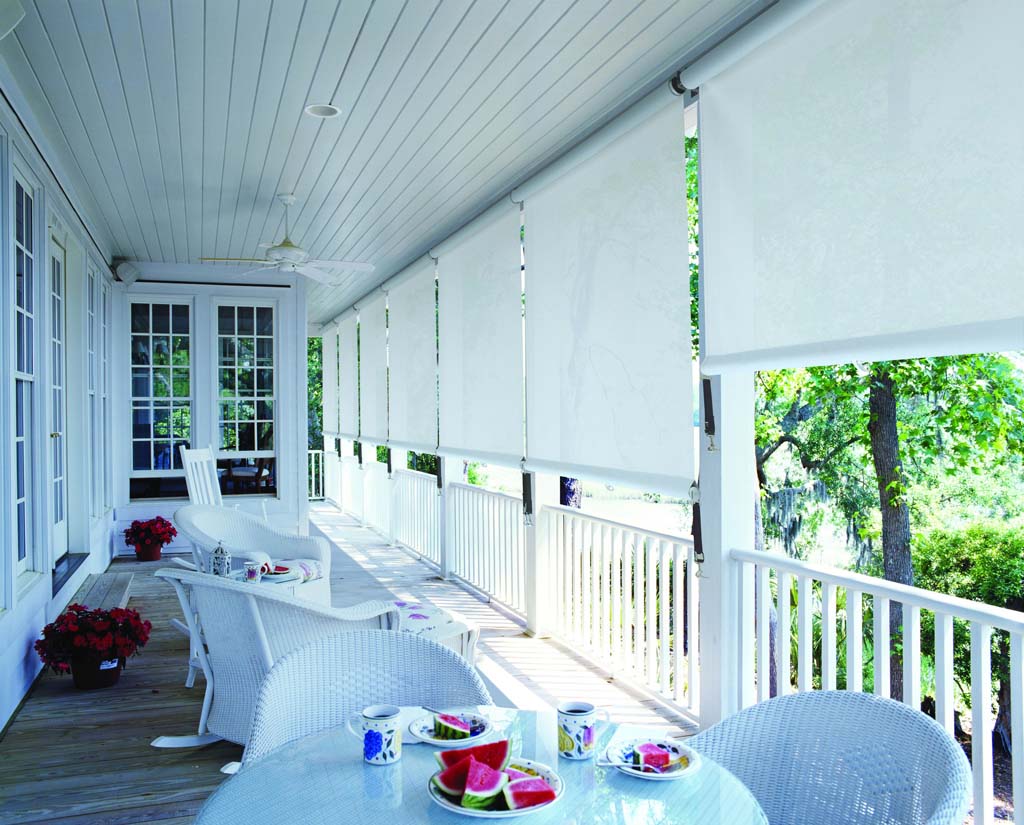
The Evo range is Luxaflex’s straight drop and external blind series, designed for window shading and privacy rather than overhead coverage. These are external roller-style systems that drop vertically from above a window or balcony edge, providing UV protection and heat reduction while still allowing airflow through open-weave sunscreen fabrics.
The Evo range uses Spectra Sunscreen fabric, which is built on fibreglass yarn with Enduris Glass Core Technology. This gives the fabric exceptional tensile strength and UV resistance. The Evo MagnaTrack variant uses a magnetic side channel system that holds the fabric edge under tension, dramatically improving wind performance compared to standard cable-guided drop systems.
For apartments and townhouses in Leichhardt, Concord, or Five Dock where an overhead folding arm system is not practical, the Evo range is one of the most effective external shading solutions available.
Visit luxaflex.com.au for the full range of Luxaflex awnings, or visit DDI’s Russell Lea showroom to see fabric and hardware samples in person.
Awnings and Energy Savings: What to Expect
Awnings are not just about outdoor comfort. A well-positioned awning on a west or north-facing wall can meaningfully reduce heat gain inside your home. Research on external shading consistently shows that a significant portion of summer heat enters through unshaded glass, and blocking that solar load before it hits the window is far more effective than managing it with internal blinds after the fact.
For Sydney homes, the practical effect is reduced running time for air-conditioning during the peak afternoon hours of January and February. The actual saving depends on your home’s construction, orientation, the awning fabric’s openness factor, and how often you use the awning. A solution-dyed acrylic in a mid-tone colour, correctly deployed over a west-facing living room window in Balmain or Annandale, can make a real difference to afternoon comfort, not just aesthetics.
Motorised awnings with sun sensors take this further. Set the sensor threshold once, and the awning responds automatically to changing conditions across the day without any action required from you.
Balcony and Outdoor Living Awnings
Balcony installations present specific challenges that ground-floor patio awnings do not. Mounting substrate matters: a timber-framed balcony fascia, a rendered masonry wall, and a steel-framed apartment parapet all require different fixings, brackets, and load calculations. Installing an awning incorrectly on a balcony is a safety risk, not just an aesthetic one.
DDI has been measuring and installing awnings in Inner West apartments, terrace homes, and Federation bungalows since 1991. We know the common wall constructions in this area. We know which substrates require specialist fixings, and we know which Luxaflex models are suited to narrow terraces with limited projection clearance.
For strata-titled properties in Drummoyne, Rozelle, or Five Dock, awning installations typically require approval from the owners’ corporation before work proceeds. The approval process usually involves submitting specifications, including fabric colour and hardware finish, to ensure the installation matches the building’s approved palette. DDI can provide the specification documentation needed for strata approval applications.
The Luxaflex Ventura Terrace is specifically designed for narrow balconies and apartment buildings where standard folding arm models are too wide. Its arms offset vertically rather than side by side, allowing a longer projection in a narrower footprint.
Wind Ratings and Durability
This is the section most Sydney awning pages skip, and it is arguably the most important practical consideration for Inner West homeowners.
Retractable awnings are not designed to remain deployed in high winds. In strong gusts, an unretracted folding arm awning can flex, strain the arms, damage the fabric, and, in extreme cases, pull the mounting brackets away from the wall. The general advice from manufacturers is to retract folding arm awnings when sustained winds exceed approximately 50km/h.
For properties in exposed locations, particularly those with elevated balconies, open north-facing aspects, or proximity to the harbour around Drummoyne, a wind sensor is a sensible investment. The sensor monitors wind speed continuously and triggers automatic retraction before conditions reach a damaging threshold. Paired with a motorised drive, this is a set-and-forget safety system.
Full-cassette awnings protect the fabric and hardware when retracted, which significantly extends the life of the installation in Sydney’s variable weather. Open roller systems leave the fabric exposed to UV and moisture year-round, which accelerates degradation even when the awning is not in use.
Frame quality is also a durability factor. Powder-coated aluminium frames resist the salt air common in bayside Inner West suburbs far better than painted steel. Marine-grade fasteners should be specified for any installation within a few kilometres of the harbour. DDI sources hardware to these standards as part of our standard installation process.
Custom Awnings vs Off-the-Shelf
A commonly asked question is whether a custom-measured and installed awning is worth the cost premium over an off-the-shelf unit purchased online or from a hardware chain.
The answer depends on what you are covering. For a small, standard window on a ground-floor brick wall with simple access, an off-the-shelf awning is a practical option if you are confident with installation. For anything more complex, a custom supply-and-install job from an authorised dealer is the safer choice.
Custom awnings are sized precisely to your opening. They are specified for your wall substrate. The fabric is chosen for your aspect and UV exposure. The motor or crank is selected for the width. The pitch is set at the angle that best suits your sun exposure in your suburb. Off-the-shelf units require compromise on some or all of these variables.
Beyond fit, there is the warranty question. Luxaflex awnings supplied through authorised dealers carry manufacturer warranties on both fabric and mechanism. The Spectra Sunscreen fabric range carries a five-year fabric warranty. Off-the-shelf products typically carry shorter or more limited warranties, and support after the sale is often limited to a returns process rather than a service call.
DDI provides a free measure and quote service across Inner West Sydney. We bring fabric and hardware samples to the consultation so you can see and compare in your actual space, in your actual light, before making any commitment.
How Much Do Awnings Cost in Sydney?
Pricing for awnings in Sydney depends on size, style, fabric, and whether you are adding motorisation. The ranges below reflect custom supply-and-install pricing through an authorised dealer in 2026.
Fabric folding arm awnings (crank-operated): Custom-made folding arm awnings in standard sizes typically start from around $2,700 for a smaller manually operated system. Mid-range systems for a 4 to 5 metre wide entertaining area in a standard configuration run from $3,500 to $5,000 installed, depending on fabric selection and cassette type.
Motorised folding arm awnings: Adding a quality motorisation system to a folding arm awning adds $400 to $800 to the base price. For a full-cassette motorised system from the Luxaflex Contemporary Series with a wind sensor, budget $5,500 to $9,000 depending on width and specification.
Straight drop and Evo-style awnings: External roller-style systems for windows and balcony edges start from around $800 to $1,500 per window for a simple motorised installation, with pricing scaling based on width.
Wind and rain sensors: These add $200 to $400 to any motorised system and are strongly recommended for exposed or elevated locations.
These figures are a general guide. Final pricing depends on your specific measurements, substrate conditions, fabric choice, and access. The only accurate figure is the one we give you after measuring your space in person.
Why Choose Decorating Decor Interiors?
DDI has been operating from our Russell Lea showroom since 1991, for more than three decades of measuring, installing, and servicing awnings across Inner West Sydney. We are an authorised Luxaflex dealer and Hunter Douglas Gallery dealer. That distinction matters because it means we supply the full range, not a curated subset, and we have access to installation support and warranty backing that independent retailers do not.
We are not an online-only operation. You can visit our showroom at 104 Hampden Road, Russell Lea, handle fabric samples in person, and compare hardware finishes side by side before committing. When you order through DDI, the same team that sells you the awning installs it.
We know Inner West homes. We know the wall constructions, the strata requirements, the afternoon sun angles in Balmain and the harbour wind exposure in Drummoyne. That local knowledge takes years to build, and it shows in how we spec and install.
Frequently Asked Questions
What types of awnings work best on an Inner West terrace house?
Terrace homes typically have a limited outdoor footprint and may have a narrow frontage or rear courtyard. A compact folding arm awning with a semi-cassette or full-cassette housing suits these spaces well. The Luxaflex Ventura Terrace model is specifically designed for narrow balconies and terraces where standard arm spans cannot be accommodated side by side.
How much does it cost to install an awning in Sydney?
Custom supply-and-install pricing for awnings in Sydney starts from around $2,700 for a small crank-operated folding arm system. Motorised systems in mid-range sizes typically run from $4,500 to $8,000 installed, depending on width, cassette type, and sensor additions. The only accurate quote is the one provided after a free in-home measure.
Do I need strata approval to install an awning on my balcony?
For strata-titled properties, most owners’ corporations require written approval before any external alteration, including awning installation. DDI can provide the product specifications, fabric colour references, and hardware finish details typically required for a strata approval submission. We recommend checking your bylaws before booking.
What is the difference between a folding arm awning and a straight drop awning?
A folding arm awning projects horizontally outward from the wall and is primarily used to shade patios, decks, and entertaining areas. A straight drop awning, sometimes called an external roller blind, drops vertically from above a window or balcony edge to block sun and glare from entering through the glass. Many Inner West homes benefit from having both types in different locations.
Are motorised awnings worth the extra cost?
For awnings wider than around 4 metres, motorisation is worth the investment on both convenience and fabric longevity grounds. Motorised awnings extend and retract evenly across the full width, avoiding the uneven fabric tension that manual cranking can create on large spans. Adding a wind sensor means the awning retracts automatically in strong conditions, protecting the system without requiring you to be home.
Do you install Luxaflex awnings across Inner West Sydney?
Yes. DDI installs Luxaflex awnings throughout Inner West Sydney, including Drummoyne, Balmain, Leichhardt, Rozelle, Annandale, Five Dock, Concord, and surrounding suburbs. We supply the full Luxaflex awning range from our Russell Lea showroom, including the Contemporary Series, Evo, and SunRain models.
How do I maintain a fabric awning?
Fabric awnings should be cleaned at least once a season with mild soapy water and a soft brush. Do not use high-pressure hoses on the fabric or hardware. Retract the awning during heavy rain and strong winds to prevent unnecessary stress on the mechanism. For solution-dyed acrylic fabrics, an annual inspection of the stitching and tension is a good habit, particularly after the first summer of use.
Can an awning reduce my energy bills?
A correctly positioned awning on a north or west-facing wall can reduce heat gain through unshaded glass during peak summer hours, which reduces the demand on air-conditioning. The practical savings vary based on your home’s construction, the awning fabric’s openness factor, and how consistently the awning is deployed during the hottest parts of the day. Motorised sun sensors automate this process for maximum effect.
What is the lead time from order to installation?
Lead times for custom awnings vary by model and season, and are typically longer in the months leading into summer when demand peaks. As a general guide, allow four to eight weeks from confirmed order to installation for most Luxaflex models. DDI will give you a specific lead time estimate at the time of quoting based on current production schedules.
Do you offer a free measure and quote for awnings?
Yes. DDI provides a free in-home measure and quote service across Inner West Sydney. We bring fabric and hardware samples to the consultation so you can make a fully informed choice before ordering.