
Plantation Shutters for Heritage Homes in Sydney
Plantation shutters are a permanent, louvred window covering built from PVC, timber, or aluminium and fitted directly into the window reveal or as a surface-mounted frame. For Sydney’s heritage homes, particularly Victorian terraces and Federation cottages with deep-set, out-of-square sash windows, standard off-the-shelf coverings rarely fit properly. Custom-milled shutters solve this by compensating for structural movement while meeting current child safety and wind load standards required across New South Wales.
Table of Contents
- What Are Plantation Shutters? A Technical Overview
- How Plantation Shutters Perform in Sydney’s Climate
- Choosing the Right Plantation Shutters for a Heritage Home: Options Compared
- Plantation Shutter Costs in Sydney: Realistic Price Ranges
- The Installation Process: What to Expect
- Frequently Asked Questions
What Are Plantation Shutters? A Technical Overview
Plantation shutters are rigid, hinged window coverings made from horizontal louvres, typically 63mm or 89mm wide, set inside a fixed frame: an L-frame for surface mounting over an existing architrave, or a Z-frame recessed into the window reveal. Each panel tilts on a central rod or hidden tilt mechanism, controlling light and airflow without cords.
Frame choice matters as much as material on a heritage property. An L-frame sits proud of the wall and suits homes where the existing architrave is too damaged or shallow to recess into. A Z-frame, by contrast, tucks the shutter frame inside the window opening itself, preserving the original architrave detail, which is usually the preferred option for Inner West terraces and Federation homes where street-facing trim is part of the building’s heritage character.
| Material | Louvre Width | Best Application | Key Trait |
| PVC / Thermopoly Polyresin | 63mm or 89mm | Bathrooms, kitchens, laundries | Fully waterproof, aluminium-reinforced core |
| Basswood / Engineered Timber | 63mm or 89mm | Living areas, bedrooms | Lightweight, fine, uniform grain, paintable |
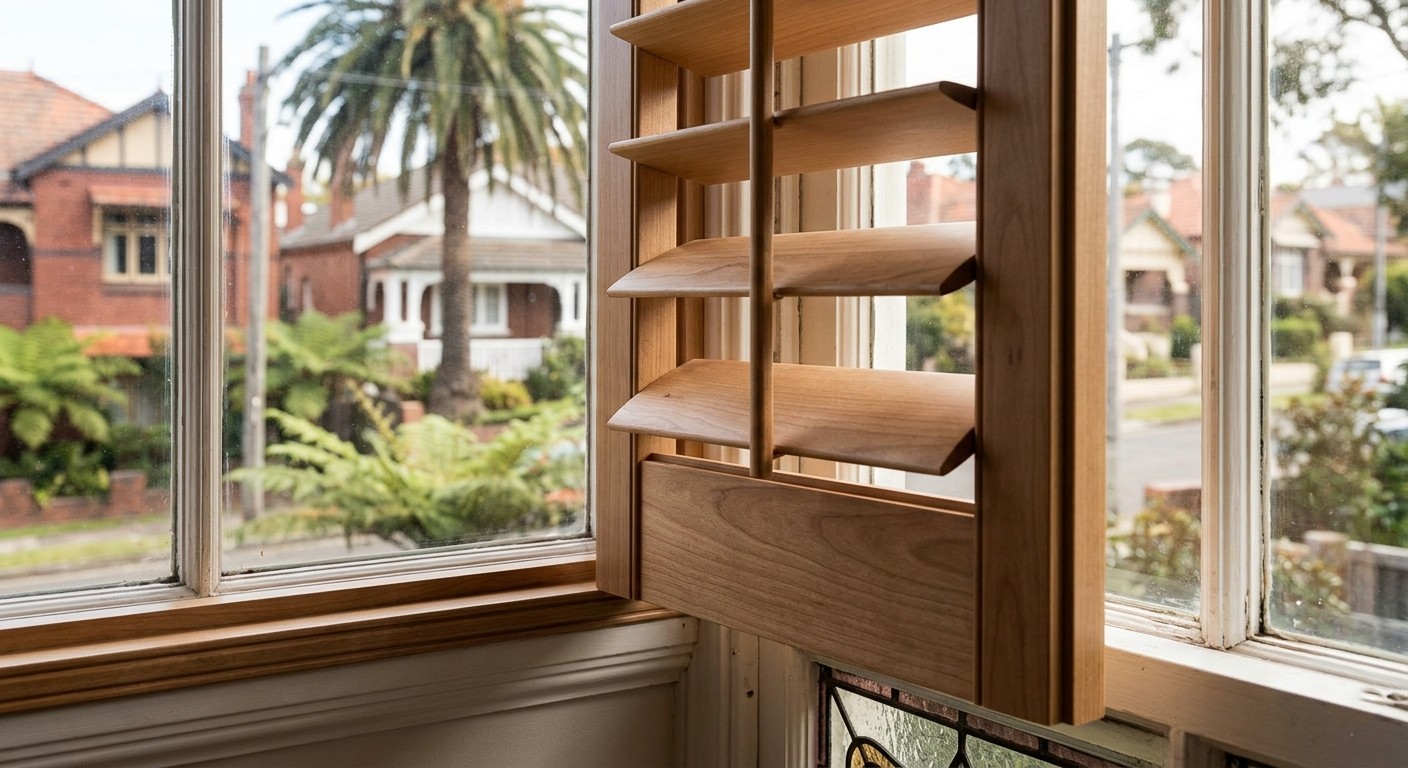
| Natural Hardwood (White Teak) | 89mm | Heritage formal rooms | High density, deep grain, matches period joinery |
| Aluminium (External Grade) | 89mm | Courtyards, balconies, patios | Marine-grade 6063-T6 alloy, security rated |
How Plantation Shutters Perform in Sydney’s Climate
Sydney’s older homes lose and gain heat primarily through single-glazed, out-of-square sash windows, which can account for up to 88% of total summer heat transfer. Custom-milled plantation shutters close this gap by forming a sealed air barrier against the frame once closed, while meeting AS/NZS 4286:2007 cord safety and, where external aluminium systems are involved, AS/NZS 1170.2 wind load requirements.
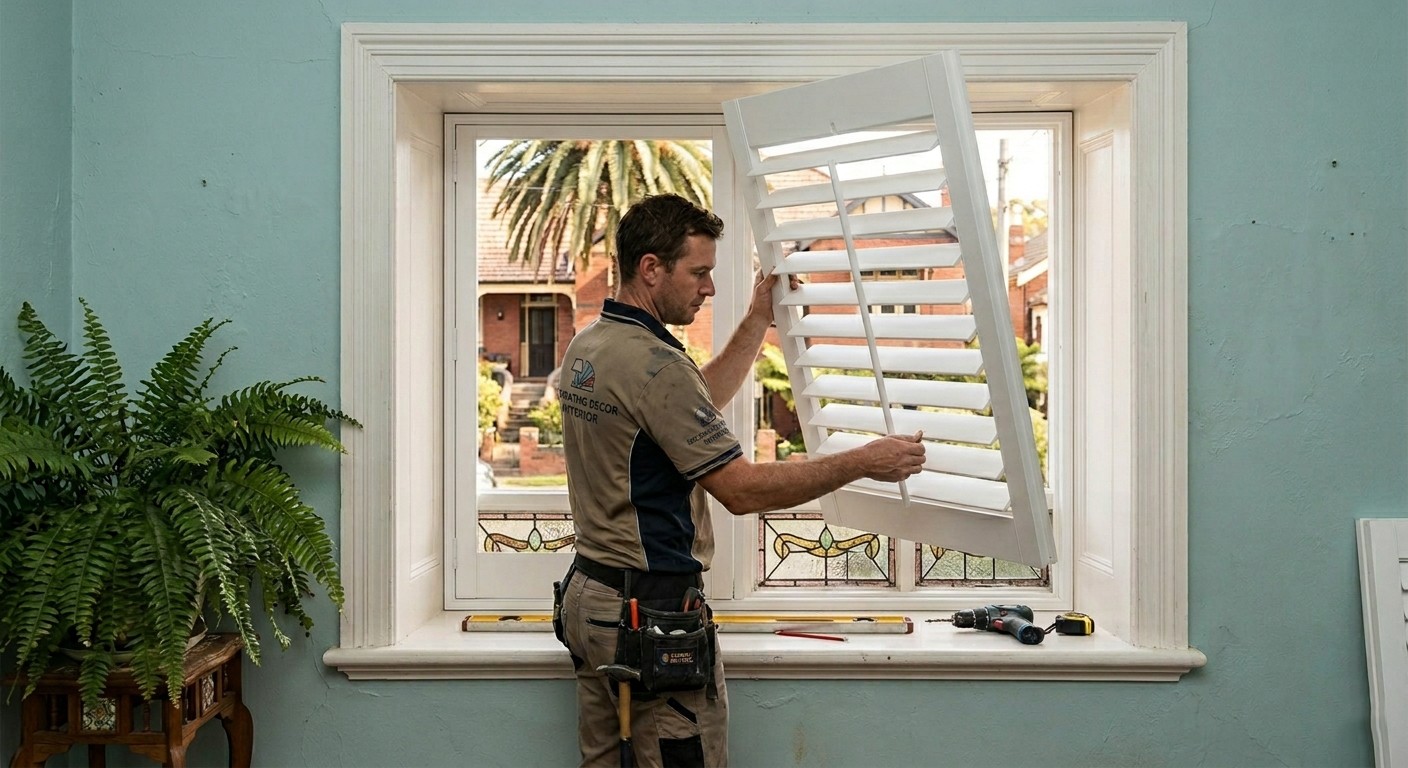
Victorian terraces and Californian bungalows across Balmain, Leichhardt, Strathfield, and Paddington share a common problem: decades of timber movement have left sash windows out-of-square, sometimes by 10mm to 15mm corner to corner. Off-the-shelf shutters can’t account for that. Each panel here is measured and milled to the individual opening, not to a standard size, which is the only reliable way to get a tight seal on a window that was hung 100 years ago.
Waterfront and bayside properties around Drummoyne, Balmain, and Rose Bay face a second issue: intense afternoon UV combined with salt-laden air, which fades fabric coverings and warps cheap vinyl within a few seasons. Thermopoly polyresin shutters use a non-toxic polymer core with aluminium reinforcement, so they won’t warp, crack, or discolour under direct sun or coastal humidity, making them the standard recommendation for wet areas and exposed facades.
In tighter, high-density streets such as Newtown, Leichhardt, and Concord, adjustable louvres let homeowners angle the blades upward to bounce daylight off the ceiling and keep air moving, without opening the room to street-level sightlines the way a raised roller blind does.
Rule of thumb: any sash window built before 1960 should be measured on-site rather than quoted off architrave dimensions alone. Decades of structural settling mean two corners of the same window can differ by over a centimetre, and that variance has to be built into the frame, not painted over with packing or filler.
Choosing the Right Plantation Shutters for a Heritage Home: Options Compared
Material selection on a heritage property comes down to room function, not personal taste alone. Natural hardwoods such as White Teak carry the grain depth and density expected in formal living rooms and street-facing facades, where the shutters are effectively part of the home’s architectural presentation. Basswood is lighter and takes paint cleanly, which suits bedrooms and secondary living areas where budget matters more than display value. Thermopoly is the only sensible choice for bathrooms, kitchens, and laundries, since timber will absorb moisture and swell in those rooms regardless of finish quality. Aluminium is reserved for external applications, courtyards, balconies, and street-facing security shutters, where powder coating over 60 microns (per AS 3715:2002) is needed to resist UV and salt corrosion.
For a typical double-fronted Federation home in the Inner West, a practical specification is White Teak or Basswood in the front rooms to match the period detailing, paired with Thermopoly in the bathroom and laundry, and external aluminium only if a courtyard or balcony needs additional privacy or security. Mixing materials by room, rather than running one product through the whole house, is standard trade practice and keeps the long-term maintenance bill down.
Plantation Shutter Costs in Sydney: Realistic Price Ranges
By window type (supply and install):
| Window Type & Dimensions | PVC / Polyresin | Timber / Basswood | Tier |
| Small Window (~900 × 900mm) | $550 – $800 | $700 – $1,000 | Entry Level |
| Standard Window (~1200 × 1200mm) | $750 – $1,100 | $900 – $1,400 | Mid-Range |
| Large Window (~1500 × 1200mm) | $1,000 – $1,500 | $1,200 – $1,800 | Mid-Range |
| Sliding Door / Bifold Panel (per span) | $1,400 – $2,200 | $1,800 – $3,000 | Premium |
| Bay Window (3-Panel Assembly) | $2,000 – $3,500 | $2,500 – $4,500 | Premium |
By square metre (supply and install):
| Material | Price per m² | Best Application |
| PVC / Thermopoly Polyresin | $300 – $650 | High-moisture rooms, fully waterproof |
| Basswood / Engineered Timber | $500 – $800 | Living areas and bedrooms |
| Natural Hardwood (White Teak) | $700 – $1,000+ | Heritage homes, formal rooms |
| Aluminium (External Grade) | $500 – $900 | Courtyards, balconies, patios |
Whole-home packages:
- Apartments / small terraces (4–6 windows): $3,000 – $7,000
- Standard single-storey homes (10–12 openings): $7,500 – $11,000
- Large character or double-storey heritage homes (14–18 openings): $9,500 – $18,000+
- Separate installation labour (if not bundled): $70 – $100 per hour
The main cost variables are material, window shape (bay and arched openings cost more to mill), and whether the installation is a single span or a multi-panel assembly. Premium hardwood shutters carry a higher upfront cost than fabric blinds, but last 15 to 25 years against the 5 to 7 year replacement cycle typical of curtains and roller blinds, which is the figure most homeowners weigh up before committing to timber over a cheaper interim option.
The Installation Process: What to Expect
- Measure and quote. A trade installer measures every window individually on-site, since heritage frames are rarely square. For street-facing external work in a heritage conservation area, this is also when a council DA requirement (if applicable) gets flagged.
- Heritage and council check. Internal timber shutters are generally exempt from development under Inner West Council and City of Sydney rules. External aluminium shutters on a street-facing facade usually require a Development Application, since councils control street appearance closely in conservation areas.
- Custom milling. Panels are cut and assembled to the exact window dimensions, including L-frame or Z-frame selection, louvre width, and any compensation for out-of-square openings.
- Installation. Frames are fitted, and panels hung on-site, with cord tensioners and warning labels affixed per AS/NZS 4388:2014, and a permanent installer label attached as required by trade practice regulations.
- Lead time and warranty. Standard lead time runs 3 to 6 weeks from confirmed measure to installation, depending on material and panel count. Warranty terms vary by product line, with premium Thermopoly and powder-coated aluminium ranges typically carrying the longest cover.
- Aftercare. Timber shutters benefit from a wipe-down with a dry or barely damp cloth; PVC and Thermopoly can be cleaned with mild detergent. Hardwood in direct sun exposure may need repainting or refinishing after 10 to 15 years.
Frequently Asked Questions
How much do plantation shutters cost in Sydney? Supply and install for a standard-sized window runs from $300 to $500 with entry-level PVC, up to around $1,400 for premium timber. A full home installation typically lands between $7,000 and $18,000, depending on total square meterage, material, and window complexity. Where installation is billed separately, labour runs $70 to $100 per hour.
Are plantation shutters worth the investment? Yes, for most heritage homeowners. They last 15 to 25 years, block up to 88% of summer solar heat gain, and are treated as a permanent fixture that adds to a property’s resale value, unlike curtains or blinds, which are replaced every 5 to 7 years.
What is the difference between timber and PVC plantation shutters? Timber, such as Basswood or White Teak, is lightweight and naturally rigid, suited to dry living areas and bedrooms where the grain can be stained or painted to match period interiors. PVC and Thermopoly are heavier, completely waterproof, and reinforced with an internal aluminium core, making them the correct choice for bathrooms, kitchens, and laundries.
Do you need council approval for window shutters in a heritage conservation area? Internal timber shutters are generally exempt from development under Inner West Council and City of Sydney rules. External aluminium shutters on a street-facing facade are far more restricted and usually require a Development Application, since councils prioritise preserving the historic street appearance.
How long do custom plantation shutters last? Well-installed plantation shutters typically last 15 to 25 years. Thermopoly and powder-coated aluminium have the longest service life with minimal upkeep, often backed by warranties up to 25 years. Hardwood lasts just as long structurally, but may need repainting after 10 to 15 years, depending on sun exposure.
CTA
Book a free in-home measure and quote. Our team will assess your heritage windows on-site, confirm whether your street-facing work needs council sign-off, and provide accurate timber or Thermopoly pricing for your home. Call (02) 9712 2722 or visit our Russell Lea showroom at 104 Hampden Road.