
Plantation Shutters Sydney: Custom-Fit, Expert-Installed Window Solutions
Decorating Decor Interiors has been fitting window furnishings across Sydney’s Inner West since 1991, ranging from entry-level PVC through to premium hardwood and external aluminium. Plantation shutters are permanent, custom-fabricated window coverings built from horizontal louvres set inside a hinged or track-mounted frame. Unlike soft furnishings, they’re treated as structural fixtures, which changes how they’re priced, certified and maintained. This guide covers material options, the NSW compliance standards that apply, realistic Sydney pricing, and what happens on installation day.
Table of Contents
- What Are Plantation Shutters? A Technical Overview
- How Do Plantation Shutters Perform in Sydney’s Climate?
- Choosing the Right Plantation Shutters: Options Compared
- Plantation Shutter Costs in Sydney: Realistic Price Ranges
- The Installation Process: What to Expect
- Frequently Asked Questions
What Are Plantation Shutters? A Technical Overview
Plantation shutters are rigid window coverings built from horizontal louvred slats, usually 63mm, 89mm or 114mm wide, set inside a perimeter frame and rotated by a tilt rod or concealed mechanism. The frame is hinged for swing-open panels or track-mounted for bi-fold and sliding configurations.
Three things determine how a panel sits and operates: frame type, tilt mechanism, and configuration.
Frame type. An L-frame face-fixes to the wall and sits proud of the window reveal, useful where the reveal itself is uneven. A Z-frame recesses flush inside the opening for a cleaner, built-in look. A reveal or inside-mount fit suits deep window reveals where the frame can sit entirely within the recess.
Tilt mechanism. A centre tilt rod is the traditional setup, a visible vertical rod running down the middle of each panel. A hidden or rear tilt mechanism keeps the rod behind the louvres, giving an unbroken sightline through the window and reducing the seams through which light can pass.
Configuration. Hinged panels swing open like a cupboard door and suit standard windows and French doors. Bi-fold panels fold back along a track for wide openings. Sliding panels run on an overhead track to clear sliding glass doors. Café-style covers only the lower half of the window, leaving the upper glass exposed for light while screening the sightline from the street.
| Material | Best Suited To | Moisture Resistance | Max Panel Span | Typical Warranty |
| PVC / Hollow Vinyl | Budget interior rooms, rental properties | Good, no internal reinforcement | Narrower openings only | 5 to 10 years |
| Reinforced Polyresin (e.g. Thermopoly) | Bathrooms, kitchens, laundries, high-humidity rooms | Excellent, fully waterproof | Wider spans than PVC due to aluminium core | Up to 20 to 25 years on premium ranges |
| Timber (Basswood / Hardwood) | Living areas, bedrooms, heritage facades | Moderate, not suited to wet areas | Wide spans on quality hardwood | Up to 20 to 25 years on premium ranges |
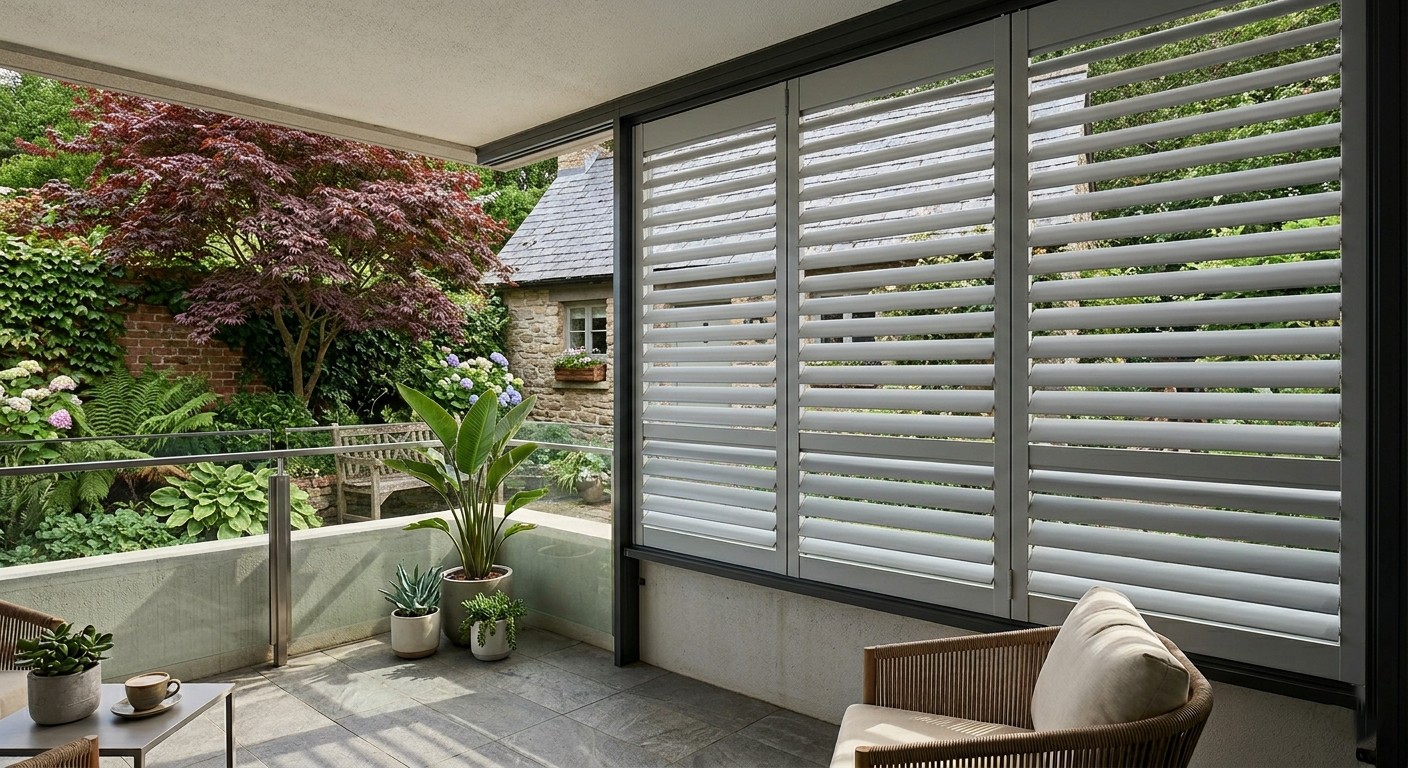
| Aluminium | External patios, balconies, security applications | Excellent, fully weatherproof | Up to 1,200mm per panel | Up to 20 to 25 years on premium ranges |
How Do Plantation Shutters Perform in Sydney’s Climate?
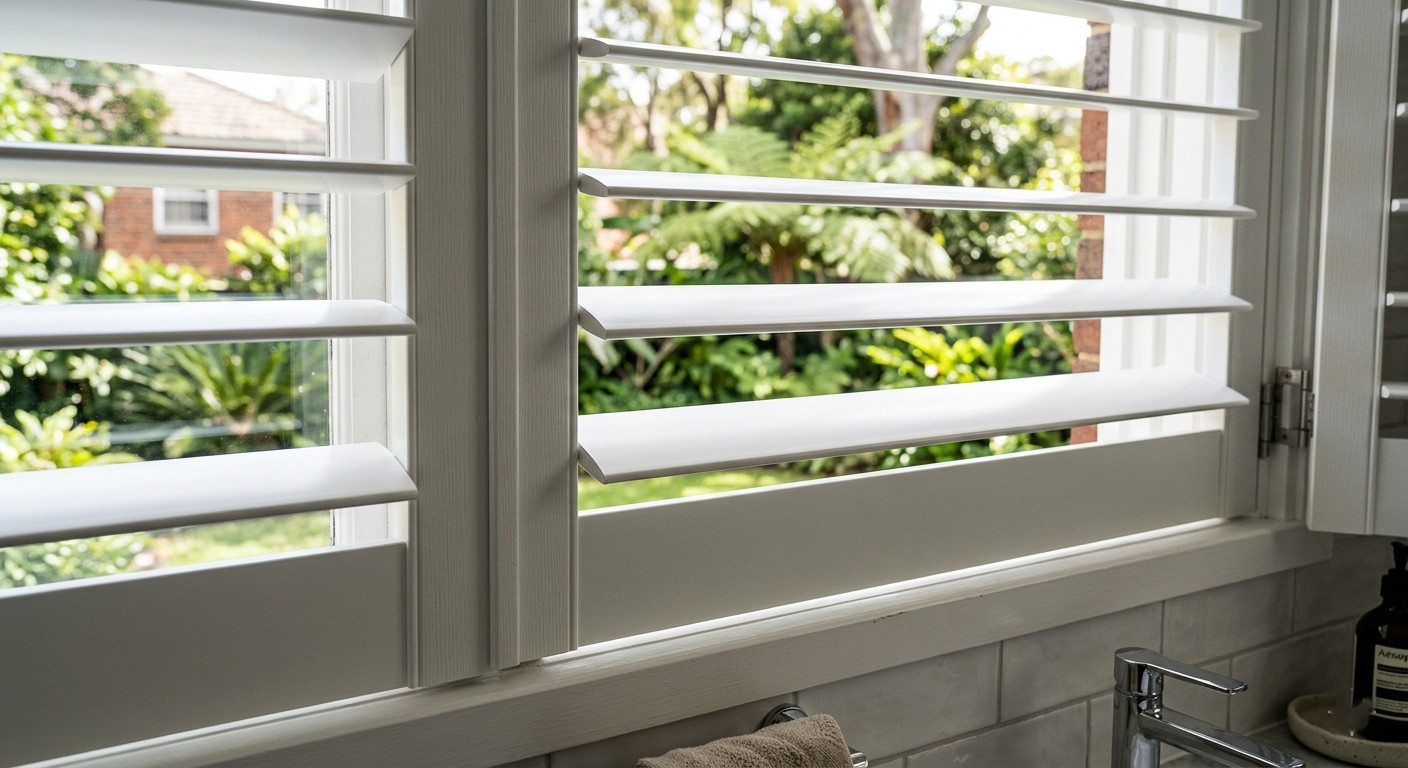
Sydney shutters face three distinct pressures: high summer thermal gain through unshaded glazing, coastal humidity that warps untreated timber, and, in bushfire-prone fringe suburbs, strict construction standards. Up to 88% of a home’s summer heat load enters through window glass, while harbourside humidity in suburbs like Drummoyne and Concord pushes lesser materials toward warping, swelling and mould.
Thermal gain. Custom-fit shutters create a sealed air gap against the glass, reflecting up to 30% of incoming solar heat rather than letting it radiate straight into the room. In western and central Sydney, where inland temperatures regularly climb past 40°C in summer, this passive barrier takes real pressure off air conditioning systems rather than just dressing the window.
Coastal humidity. In harbour-fronting suburbs (Drummoyne, Five Dock, Balmain, Concord), persistent humidity is the bigger threat to standard timber and MDF window treatments, which swell, peel and harbour mould in bathrooms and laundries. We specify Thermopoly polyresin (Thermo25) for these rooms specifically because it’s fully waterproof and won’t crack, warp or peel under sustained moisture exposure.
Urban density and privacy. Inner West terrace housing (Balmain, Leichhardt, parts of Concord) brings a different problem: narrow streets and windows that open directly onto footpaths or neighbouring properties. Heavy curtains solve privacy but kill airflow and natural light. Hinged or sliding shutters let residents angle the louvres to block sightlines from the street while still drawing light and cross-ventilation into the room.
Compliance standards that apply:
AS/NZS 4388:2014 governs cord safety on any internally operated shutter using a pull-cord, chain or tensioner. The mechanism must prevent a loose loop of 220mm or longer from forming below 1,600mm from the floor, and tension devices fitted below that height must withstand 70N of force for 10 seconds without failing. Cord cleats need secure anchoring, and a permanent installer ID label plus a warning tag must remain on the unit. Breaches sit under the Australian Consumer Law, where corporate penalties can reach $50 million.
AS/NZS 1170.2:2021 covers wind actions and applies to external aluminium shutters on balconies, alfresco areas and high-rise facades. Wind pressure is calculated from regional wind speed, terrain category, shielding and topographic factors using p = 0.5 × ρ_air × (V_des,θ)² × C_fig × C_dyn. In practice, this means external units need reinforced mounting rails and stainless fasteners rated for the specific exposure of the installation site, not a generic fixing kit.
AS 3959-2018 sets the Bushfire Attack Level (BAL) requirements for homes bordering bushland in northern and western Sydney. Standard PVC shutters are not permitted in BAL-rated zones because the polymer melts under radiant heat. Components rated for BAL-40 are tested under AS/NZS 1530.8.1 to withstand 40kW/m² of radiant exposure, while BAL-FZ (Flame Zone) installations are tested under AS/NZS 1530.8.2, requiring the unit to hold structural integrity through a 30-minute furnace test followed by a water hose-stream test.
AS 2663-1999 governs material performance, requiring a lightfastness rating of 7 or higher on the Blue Wool Scale so shutters don’t yellow, fade or crack under harsh Australian UV. Reinforced security shutters are tested under AS 5039-2008 and AS 5041, assessing the full unit (frame, hinges and locking hardware) for dynamic impact and forced-entry resistance. Any motorised or smart-home shutter must also comply with AS/NZS 60335 for electrical safety.
Rule of thumb: if a window sits within reach of a harbour-facing wall, a bathroom extractor fan, or a known damp corner, we spec solid polyresin over timber every time, no exceptions.
Choosing the Right Plantation Shutters: Options Compared
The right shutter material depends on the room, not personal preference alone. Wet areas need a waterproof, non-warping product; living areas can carry timber’s grain and warmth; large openings and sliding doors need a material strong enough to span the gap without sagging; and exterior applications need a weatherproof, structurally rated unit.
Bathroom, kitchen and laundry. Reinforced polyresin (Thermopoly) is the standard recommendation. It’s completely waterproof, won’t swell or peel, and resists the black mould that develops on conventional timber and MDF in these rooms.
Living rooms and bedrooms. Timber, particularly kiln-dried hardwood, suits these spaces for its grain, weight and paint finish options. It performs well away from direct moisture and can be stained or painted to match existing trim.
Sliding doors and wide openings. Track-mounted polyresin or timber bi-fold systems handle openings standard hinged panels can’t. These need a tracking surcharge to cover the overhead guide hardware (see pricing below).
External patios, balconies and security applications. Aluminium is the only material rated for both structural wind load and, where fitted with reinforced hardware, security certification under AS 5039-2008.
For a typical Inner West terrace, a bathroom facing a side lane and a street-facing living room, we’d usually spec Thermopoly in the wet area and a mid-tier painted hardwood through the living spaces, keeping a consistent louvre size across the front facade for street appeal.
Plantation Shutter Costs in Sydney: Realistic Price Ranges
Sydney plantation shutter pricing runs in three tiers based on material and structure. Entry-level PVC starts around $300 to $500 per standard window. Mid-range reinforced polyresin or painted timber sits between $500 and $900 per window. Premium hardwood, aluminium and custom shapes start at $1,000 to $1,500 or more per window, supply and install.
| Tier | Standard Window (approx. 1200mm x 1200mm) | Per m² (Supply & Install) | Typical Materials |
| Low-Range / Entry-Level | $300 – $500 | $250 – $350/m² | Basic PVC or hollow vinyl, factory-preset white, recess-fit |
| Mid-Range / Residential Standard | $500 – $900 | $350 – $700/m² | Reinforced polyresin (Thermopoly/PolySatin), painted basswood or timber |
| Premium / High-End Architectural | $1,000 – $1,500+ | $700 – $1,300+/m² | Kiln-dried hardwood, custom shapes, external powder-coated aluminium |
Variables that change the final quote:
Labour: independent contractors in Sydney charge $35 to $95 per hour, with specialist custom shutter installers charging $70 to $100 per hour.
Minimum billable area: most suppliers enforce a 0.5 to 1.0 square metre minimum per panel, so small windows in powder rooms and laundries are often billed at the full 1.0m² rate regardless of actual size.
Sliding and bi-fold door tracks: large sliding or alfresco openings need overhead tracking hardware, adding roughly $500 per door opening and lifting the effective rate to $450 to $700 per m² for tracking-mounted timber or PVC.
Custom colour matching: matching a specific Dulux or Interpon shade outside the standard finish range adds up to $500 per order to cover specialised paint mixing and clean-down.
Geometric shapes: arched, circular, triangular or raked windows need hand-drafted templates and manual assembly, adding $40 to $200 per square metre above standard pricing.
The Installation Process: What to Expect
- In-home measure and quote. A consultant measures each opening and confirms frame type, tilt mechanism, configuration and material against the room’s exposure (wet area, external, bushfire zone, and so on).
- Material and finish selection. Choose louvre width, frame style and colour, including any custom paint matching.
- Custom fabrication. Panels are built to the confirmed measurements at the supplier’s workshop. Fabrication timing is confirmed at the point of order, since it varies by material, finish and order volume.
- Delivery and site check. Frames and panels arrive on-site, and measurements are rechecked against the opening before fitting begins.
- Professional installation. A qualified installer levels and fixes the frame, hangs the panels, and tests every hinge, tilt rod and tracking guide before signoff.
- Aftercare and warranty. Warranty terms apply from the installation date, ranging from 5 to 10 years on entry-level products up to 20 to 25 years on premium polyresin, timber and aluminium ranges. DIY installation can void these terms if the frame isn’t square, since structural fixtures depend on precise levelling to hold their warranty.
Frequently Asked Questions
Do plantation shutters add value to a home?
Yes. Custom-fabricated shutters are classified as permanent, built-in fixtures rather than removable soft furnishings, which is why they’re treated as a capital improvement rather than decor. Real estate data points to an estimated 3% to 5% increase in resale value, driven by street appeal, thermal performance and the appeal of move-in-ready fittings.
Do plantation shutters keep the light out?
Not completely. Microscopic gaps between the louvres, panel edges and the surrounding frame mean shutters aren’t a 100% blackout solution. They do block significantly more ambient light than venetian blinds or light-filtering curtains. For maximum light exclusion, choose a larger louvre profile (89mm or 114mm) with a hidden, rear-mounted tilt rod, which reduces the number of horizontal seams across the opening.
How long do plantation shutters last?
Standard fabric blinds often need replacing within 5 to 7 years due to UV damage and worn cords. Quality plantation shutters typically last 15 to 25 years. Solid polyresin and aluminium are highly durable, fade-resistant and largely maintenance-free, while premium timber may need sanding and repainting after 10 to 15 years, depending on sun exposure.
Are aluminium shutters better than PVC shutters?
It depends on the application. PVC with an internal aluminium core is moisture-resistant and cost-effective, making it a strong fit for interior wet areas like bathrooms, kitchens and laundries where it won’t warp or mould. Aluminium offers greater structural strength, allowing panels to span up to 1,200mm without sagging, which makes it the better choice for external patios, high-rise balconies and security installations.
Do plantation shutters require professional installation?
Yes, for any installation expected to hold its warranty. Shutters are structural fixtures, and successful fitting depends on precise levelling. Even small measurement errors cause uneven panels, sagging hinges and operational faults. Professional installation keeps the frame square, preserves structural integrity, and protects manufacturer warranties that can run up to 20 to 25 years on premium materials.
Book a free in-home measure and quote with Decorating Decor Interiors. Visit the showroom at 104 Hampden Road, Russell Lea NSW 2046, or call (02) 9712 2722 to arrange a consultation.